The 1980s was a decade brimming with vitality and hope. Whether it was the subtle changes in the appearance of Korla or the gradual improvement of people’s living conditions, each transformation became a wheel mark on the city’s path forward, leaving deep impressions in the hearts of every person who lived through that era.
In those years, the nationwide “literature fever” ignited the blood and passion of tens of millions of literature lovers (the term “literary youth” had not yet emerged). Countless literary clubs sprang up and flourished, enthusiastically “publishing” various literary journals—those handmade mimeographed newsletters created by cutting wax paper and rolling ink drums. People eagerly exchanged and circulated them among friends, filling the city with a lively cultural buzz. As the enthusiasts aged and gradually returned to their families and careers, that loud, passionate wave of literary fervor faded quietly into the dust of memory.
In the same year, Bayingolin Daily resumed publication. On New Year’s Day of 1959, the CPC Korla Prefectural Committee launched Korla Daily. In December 1960, Korla Daily was renamed Bayingolin Daily, serving as the official newspaper of the CPC Bayingolin Mongolian Autonomous Prefecture Committee. In 1962, it ceased publication and did not reappear until twenty-three years later.
The year 1985 marked the 30th anniversary of the founding of the Xinjiang Uygur Autonomous Region. The year before—1984—was the 30th anniversary of the establishment of the Bayingolin Mongolian Autonomous Prefecture. In 1984, Korla implemented the Central Government’s directive that “the construction of spiritual civilization must begin with cleanliness and sanitation, using them as the breakthrough point.” With great fanfare, the city launched sanitation certification campaigns and the “Three Responsibilities” policy (responsibility for hygiene, for greenery, and for maintaining order outside one’s door). In 1985, Korla won third place among 16 cities in Xinjiang in the evaluation of spiritual civilization construction.
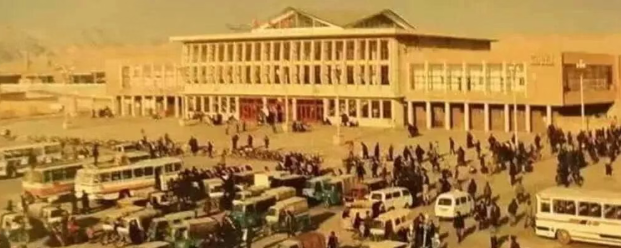
That same year, Korla East Railway Station was completed, marking the end of the era when southern Xinjiang, Bayingolin Prefecture, and Korla itself were not connected by rail. For the people of Korla, this was monumental—they could finally travel to Ürümqi or even inland China directly from home, without first taking long-distance buses to Daheyan or Ürümqi to catch a train. The birth of the East Station was truly a milestone in Korla’s transportation history.
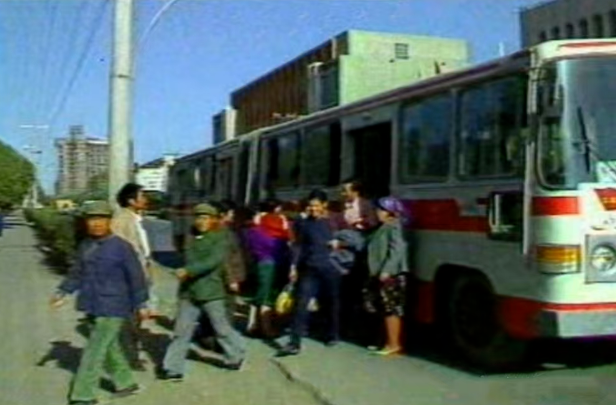
In the spring of 1985, as the city prepared to establish a taxi company, a public bus fleet was also formed. During the spring and autumn seasons, two articulated buses were purchased, opening Bus Route No. 1, stretching 9.7 kilometers from the East Railway Station to the Oil Depot of the Petroleum Company, then along Renmin East Road, Tuanjie Road, and finally to the Municipal Hospital. In September 1986, several more “Shanghai 640” buses were added to the route.
Taxi operations in Korla began in the 1970s, when the Bayingolin Postal Bureau established a three-wheeled motorcycle taxi team. In 1985, Korla’s taxi fleet was formally established, and the motorcycle taxi business ended. The Xinjiang Regional Construction Department allocated ten vehicles to Korla free of charge—three minibuses, two Shanghai sedans, and five Beijing 212 jeeps. On May 27, 1999, the Korla Taxi Company merged with the Korla Bus Company, forming the Korla Public Transportation Corporation.
One day in April 1985, two childhood friends and I went to the outdoor cinema of the Bayingolin Theatre (located at today’s “Old Huijia”). We watched the film Life, adapted from the novella by Lu Yao. While deeply empathizing with the hardships of protagonist Gao Jialin’s fate, we also found renewed courage to strive upward and persevere. At the time, the Bayingolin Theatre—Korla’s cultural hub—was as prosperous and lively as cinemas across the country. The booming film market invigorated the surrounding “street stall economy,” and Korla’s very first night market took shape here before spreading throughout the city.
In September that same year, I enrolled in the Bayingolin Branch of Xinjiang Radio & TV University as a journalism major in the class of ’85. I used the money I had saved over a year of work—money originally meant for getting married—to pay the full three-year tuition of 360 yuan at once. At that time, I was a newly regularized factory worker earning a monthly wage of 48 yuan and some change.
The Bayingolin RTVU had neither its own campus nor its own faculty. Classes were temporarily held at the Party School of the Second Agricultural Division on Jianguo South Road (beside the old Huashan Middle School). After three years of part-time study while working, I graduated in July 1988, received my junior college diploma, realized my dream of attending university, and gained a stepping stone that would change my life. Every time I pass by the building today, I look up at the third floor, remembering the countless times my classmates and I stood there—speaking passionately, full of youthful vigor—as if it were only yesterday. Looking back now fills my heart with endless emotion.
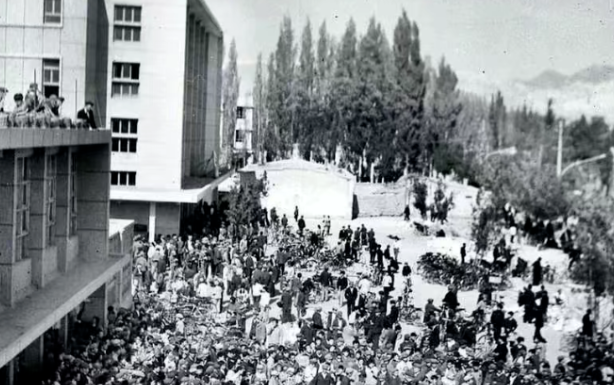
At that time, People’s Square was still an open, dusty field prone to sandstorms—a place for playing basketball, football, and track and field events. The nearby Bayingolin No. 2 Middle School used it annually as the venue for its sports meets. It also served as the gathering site for major state and municipal celebrations, often packed with crowds and excitement. On the spot where today’s Central Asia Hotel stands was once the Bayingolin Workers’ Club, where performances and plays organized by the trade union system were held. Where today’s Loulan Hotel and Bayingolin Library stand used to be the “Bayingolin First Guesthouse,” known simply as “No. 1 Guesthouse”—a cluster of single-story buildings. Around 1977, my younger siblings and I even took a commemorative photo at its entrance. Taking a picture in front of the grandest building in Bayingolin at the time felt like an honor.
In 1985, the Renmin Department Store building was completed. As the largest comprehensive state-owned mall in Bayingolin, its wide variety of goods, large inventories, and dense crowds made it the leading shopping center—not only in Korla but across the entire prefecture. It attracted shoppers from nearby counties and agricultural regiments. In terms of popularity, reputation, and business performance, Renmin Department Store was unquestionably the number one commercial powerhouse of the time.
That year, individual businesses flourished rapidly. Korla recorded 1,415 individual business households with 1,754 employees. Near People’s Square stood another landmark—the main store of Bayingolin Xinhua Bookstore. The largest bookstore in the prefecture, it was a dignified white building located on the northwest corner of the square, opposite where the Xinhua Mansion stands today. In the early years of reform and opening up, slogans like “Unite and revitalize China; realize the Four Modernizations” resonated across the nation. A massive wave of learning—culture, knowledge, and science—swept through China. As the sole provider of books at that time, the state-run Xinhua Bookstore was extraordinarily busy, drawing endless streams of readers each day.
In the 1980s, Korla’s entire meat supply was handled by the Korla Food Company, with cattle and sheep mainly procured from Hejing County. On January 1, 1985, China liberalized meat prices nationwide and lifted the rationing policy. The meat coupons used for limited purchases were abolished. People in Korla finally enjoyed the freedom to eat meat whenever and however much they wanted—provided they could afford it.
The year 1985 could be called the “first year” of color photography in Korla. That year, Fujifilm and Kodak color film first appeared on store shelves, and local photo studios began offering color photo printing. Taking a color photo was a luxury—not only expensive but requiring longer processing time compared with black-and-white photos. Gradually, black-and-white photography faded from daily life and eventually disappeared from the photographic memories of Korla residents.
At the time, the most popular spring outing (there was no term like “team building” then) destinations were the Tiemenguan Power Plant, the area under the Lion Bridge, the banks of the Peacock River (near today’s Sail Square), and around the Sunflower Bridge. Transportation mainly consisted of the “Route 11 Bus” (i.e., walking) and the classic “28-inch bicycle.” Some well-funded work units organized trips for employees to the water-lifting station at Bosten Lake—usually by riding in the back of a large truck. People would play in the water, fish for “five-strip blackfish,” cook a pot of authentic Bosten Lake fish, feast happily, and return home refreshed.
In my diary entry dated October 28, 1985, I wrote:
“Yesterday, I joyfully celebrated my 19th birthday. I am truly happy. I have stepped into another year of my life and opened a new page in the golden age of youth. This year, I emerged from confusion, hesitation, and inner conflict, and chose a new path for my life…”
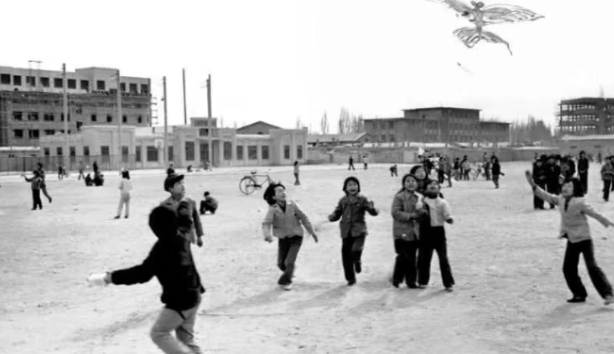
That year, today’s “Golden Triangle” area was still called “Triangle Land,” essentially an open-air street market. Western-style suits gradually became common, replacing the Zhongshan suit as the formal attire for official events. “Xiliang Beer” from Wuwei, Gansu, dominated Bayingolin’s beer market. Meanwhile, local favorites such as Wuwu Spirit, Kuitun Special, Tianshan Special, Hongshan Special, Santai Special, and Tianchi Special from northern Xinjiang were highly popular in Korla.
At the time, attending a wedding usually meant giving a 5-yuan gift; 10 yuan was considered a “big red envelope.” Small shops were known as “storefront units” or “little shops.” With no greenhouses yet, people ate only seasonal vegetables. State-owned enterprises were still categorized as “national” or “collective.” Children reaching working age could still “inherit” their parents’ job positions. That year, Bohu Paper Mill was founded and officially went into production in January 1993.
The most popular disco music of the time included Hodon, Warrior, Genghis Khan, Alibaba, Rivers of Babylon, and Moonlight Disco. Fashionable outfits consisted of “explosive perms, aviator sunglasses, wide lapels, plaid shirts, tight jeans, men’s high-heeled shoes with iron soles, and double-cassette boom boxes carried on the shoulder.”
“Faded memories seem to return; waves rise within my heart, letting go of worldly troubles and sorrows…” The theme song A Heart of Bold Gallantry from The Legend of the Condor Heroes still echoes faintly, though forty years have slipped by. We are no longer the same as we once were. Yet even as time flows on, the simplicity and sincerity of 1985 still run quietly within us, becoming the softest part of our memories—reminding us that the warmth of those old days has never truly gone, and that the beauty of the past continues to live on.